Star Bubble Retro Font for Editorial Design
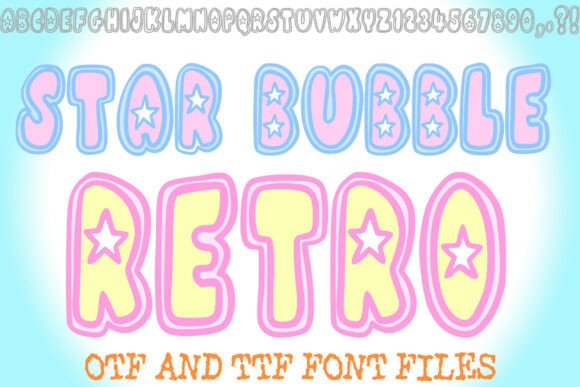
Star Bubble Retro is a handmade decorative font that brings celestial charm and playful energy to editorial layouts — especially where bold personality, visual rhythm, and instant reader recognition matter most. As a display font, it’s not built for long-form body text, but it excels where attention must be captured: magazine covers, blog headers, ebook titles, quote graphics, and branded printables. Its chunky, bubbly letterforms — with subtle star-inspired detailing and uneven baseline play — evoke retro-futurism while feeling fresh and intentional in modern digital publications.
Star Bubble Retro for Magazine Covers and Print Editorial Branding
Star Bubble Retro delivers immediate tonal clarity on magazine covers — especially for lifestyle, wellness, indie culture, or creative entrepreneurship titles. Its bold, chun structure holds up beautifully at large sizes in both CMYK print and high-res PDF exports. When used for mastheads or feature headlines, Star Bubble Retro reinforces a publication’s identity without sacrificing legibility. Pair it with a sturdy serif like Adobe Garamond or a neutral sans like Inter for body copy, and you create a clear visual hierarchy: Star Bubble Retro sets the mood; your secondary font ensures readability. For seasonal editions or themed issues — think “Stargazer Summer” or “Cosmic Wellness Guide” — this decorative font becomes part of the narrative, not just ornamentation.
Star Bubble Retro for Ebook Titles and Chapter Openers
When designing an ebook cover or chapter title page, Star Bubble Retro transforms static text into a tactile, memorable moment. Its handmade quality signals authenticity — ideal for self-published authors, coaches, and course creators who want their digital products to feel human-centered and visually distinct. Use Star Bubble Retro only for primary titles (not subtitles or bylines), and always test rendering across devices: it displays cleanly in EPUB3 and fixed-layout PDFs, though avoid embedding it in reflowable MOBI formats where font substitution may occur. For chapter openers inside the ebook, apply Star Bubble Retro sparingly — perhaps as a centered 36–48pt headline above a minimalist divider — then switch to a highly legible serif or sans serif for the first paragraph. That contrast builds anticipation and honors reader attention spans.
Star Bubble Retro for Newsletter Headers and Social Media Quote Graphics
Star Bubble Retro shines in fast-scrolling environments — particularly email newsletter headers and Instagram quote cards. Its high-energy presence stops thumbs mid-swipe and signals “this isn’t generic content.” Because it’s a decorative font designed for impact, not endurance, use it only for short, emphatic phrases: “You Belong Here,” “This Changes Everything,” or “The Cosmic Reset Starts Now.” Avoid stacking multiple lines or tight tracking — let each letter breathe. In Mailchimp or ConvertKit templates, embed Star Bubble Retro as a webfont (via @font-face) or export as crisp SVG/PNG for fallback compatibility. On social, pair it with soft gradients or matte cosmic textures — never busy backgrounds — so its celestial charm stays legible on mobile screens.
Star Bubble Retro for Printable Guides, Workbooks, and Lead Magnets
For bloggers and creators offering downloadable resources — recipe workbooks, habit trackers, wedding planning checklists, or coaching worksheets — Star Bubble Retro adds warmth and intentionality to title pages and section dividers. Its handmade character suggests care and craft, aligning perfectly with audiences seeking thoughtful, printable fonts. Because these assets are often printed at home or via local print shops, confirm Star Bubble Retro includes full Latin character sets and basic punctuation — critical for consistent output across PDF readers and printers. Use it for cover titles and major section headers only; keep body text in a clean, accessible sans serif like Lato or Open Sans. And remember: if you’re selling the printable as a commercial product (e.g., on Etsy or Gumroad), verify your license permits redistribution — most premium fonts like Star Bubble Retro include extended licenses for digital downloads and templates.
Star Bubble Retro for Blog Post Headings and Content Branding Systems
On blogs where voice and visual consistency define authority — think mindful parenting, vintage interior design, or astrology-based newsletters — Star Bubble Retro strengthens brand recognition across post headings, featured image overlays, and sidebar callouts. It works best when applied with restraint: one per article, typically as the H1, sized generously (56–72px on desktop, 36–44px on mobile), with generous line height and ample margin. Don’t force it into navigation menus or footer links — that’s where readable fonts belong. Instead, let Star Bubble Retro serve as your editorial signature: the first thing readers see, and the last thing they remember. For A/B testing, try pairing it with different body fonts — a warm serif for literary blogs, a geometric sans for tech-adjacent topics — and track engagement metrics like time-on-page and scroll depth to see how typography influences retention.
Star Bubble Retro for Wedding Invitations and Elegant Branding Projects
Despite its playful energy, Star Bubble Retro carries surprising elegance — especially when set in all caps with generous letter spacing and paired with delicate florals or metallic foil accents. It’s increasingly popular among independent stationers and wedding guide publishers who want to balance whimsy and sophistication. Use it for names, dates, and ceremony headers — not addresses or RSVP details — and always export final files as outlined vectors for print vendors. Because Star Bubble Retro is a decorative font, avoid stretching or distorting it; its charm lives in its natural proportions. For cohesive branding across save-the-dates, menus, and signage, layer it over muted pastels or deep navy rather than stark white — letting its celestial texture emerge gently, not aggressively.
Practical Notes Before You License Star Bubble Retro
- Confirm the font package includes OTF/TTF files optimized for both Mac and Windows editorial workflows.
- Check whether ligatures, stylistic alternates, or multilingual glyphs (e.g., accented characters for French or Spanish content) are included — useful for global newsletters or bilingual ebooks.
- Review licensing terms carefully: standard desktop use covers personal blogs and internal team projects, but commercial distribution (e.g., editable Canva templates, paid Notion workspaces, client-branded magazines) requires an extended license.
- Test Star Bubble Retro in your actual workflow — InDesign for print, Figma for web mockups, Affinity Publisher for hybrid exports — before committing to large-scale use.